
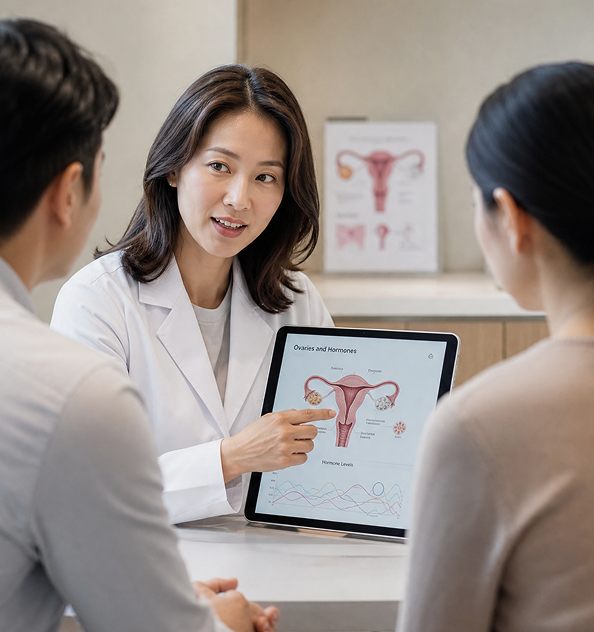
Infertility is a condition affecting numerous couples today. Regarding the treatment process, one of the crucial steps frequently discussed is “”ovarian stimulation”” to retrieve eggs for use in in vitro fertilization (IVF/ICSI). However, despite undergoing the same treatment protocol, the outcomes of ovarian stimulation often vary among individuals. A primary reason for this variance is genetic differences, specifically the FSHR (Follicle Stimulating Hormone Receptor) gene, which plays a vital role in ‘ovarian response to stimulation medication’ during the IVF/ICSI process.
The analysis of the FSHR gene assists physicians in planning the appropriate type and dosage of ovarian stimulation medication, as well as designing more suitable personalized treatments. This enhances the efficiency of the ovarian response and mitigates the risk of complications associated with hormone usage.
A blood sample is collected to test for the FSHR N680S (rs6166) gene variant, which is associated with the response to FSH.
The laboratory analyzes the genetic pattern of the FSHR gene to evaluate data that may correlate with the ovarian response to stimulation hormones.
The FSHR test results are evaluated alongside age, ovarian reserve, hormone test results, and previous responses to ovarian stimulation to develop a personalized treatment plan.
The physician utilizes all comprehensive data to select the appropriate type and determine the optimal dosage of FSH for each individual, with ongoing monitoring of ovarian response during treatment.
Follicular growth and ovarian response are closely monitored through appropriate assessments to adjust the treatment plan according to the actual conditions of each cycle.
FSHR is a FSH hormone receptor located on ovarian cells. It functions to receive signals from FSH to stimulate the growth of ovarian follicles. Individual differences in the FSHR gene can therefore affect the ovaries’ sensitivity to the hormones used for ovarian stimulation.
Information from FSHR can thus be used as part of the assessment of how each patient is likely to respond to ovarian stimulation, assisting physicians in determining a more appropriate
An optimal hormonal response is crucial for retrieving a sufficient number of eggs for treatment, particularly in individuals who have previously experienced ovarian stimulation but yielded fewer eggs than expected. Integrating FSHR genetic information with other data, such as age, AMH levels, and antral follicle count, can help physicians design a more detailed and tailored ovarian stimulation plan.
The concept of personalized treatment does not rely solely on a single test result. Instead, it involves combining multiple aspects of patient data, including genetic information like FSHR, to select the most suitable approach for each individual’s body.
For those planning to undergo IVF or ICSI, FSHR testing can serve as an additional piece of information that helps physicians plan ovarian stimulation appropriately, especially for those whose previous responses to ovarian stimulation did not meet expectations.
The number of eggs retrieved from stimulation is merely the starting point of the treatment process. The retrieved eggs must subsequently be fertilized with sperm and develop into embryos. Proper planning for ovarian stimulation therefore helps create the opportunity to obtain eggs that are ready for fertilization, ultimately leading to the selection of embryos for transfer back into the uterine cavity.
FSHR, or Follicle Stimulating Hormone Receptor, is a protein located on the surface of ovarian cells. It functions to receive signals from the FSH hormone secreted by the pituitary gland, stimulating the eggs within the ovaries to develop until they are ready for ovulation.
The function of FSHR can be compared to a “communication channel” between the brain and the ovaries. If this channel works well, the ovaries will respond fully to the hormone. Conversely, if the receptor has decreased sensitivity (or responds poorly), the use of standard ovarian stimulation medication may yield suboptimal results.
FSHR directly affects ovarian response and the number of eggs retrieved in each treatment cycle. In cases where the receptor has low sensitivity, standard ovarian stimulation medication may not induce an adequate ovarian response. Conversely, if the receptor is highly sensitive to the hormone, knowing this in advance helps doctors avoid prescribing unnecessarily high doses of medication, which reduces the risk of Ovarian Hyperstimulation Syndrome (OHSS).
Therefore, data from FSHR testing plays a crucial role in helping doctors evaluate and precisely adjust the ‘type and dosage’ of medication to suit each individual patient. This addresses the problem of poor response and prevents unnecessary overmedication, thereby safely maximizing the chances of success in IVF/ICSI.
Ovarian response to the FSH hormone varies among individuals. This is partly due to the genetics of FSHR, specifically at the N680S (rs6166) position, which is one of the key locations affecting the ‘sensitivity’ level of this hormone receptor.
Thus, FSHR gene analysis is one of the tools that help doctors design highly precise, personalized treatment plans, reduce the risks associated with unnecessary hormone use, and increase the chances of a successful pregnancy in a treatment cycle.
Applying FSHR genetic data in reproductive medicine is a novel approach that enhances the efficiency of ovarian stimulation and reduces potential complications.
Based on the FSHR gene pattern at the N680S position, doctors can select the type of ovarian stimulation hormone that better matches an individual’s physical response. Specifically:
Individuals with the S-allele gene group (Ser/Ser or Ser/Asn): Tend to respond better to urinary-derived FSH (Urinary FSH or uFSH).
Individuals with the NN gene group (Asn/Asn): Tend to respond better to synthetic FSH (Recombinant FSH or rFSH).
Selecting hormones tailored to a patient’s genetics makes ovarian stimulation more efficient and safer.
Reducing the Risk of Over- or Under-Medication
Knowing in advance whether the ovaries are likely to have a high or low response to FSH allows for much more precise dosage determination. This helps doctors avoid prescribing excessive amounts of medication, reducing the risk of Ovarian Hyperstimulation Syndrome (OHSS). At the same time, it prevents under-medication, which could result in an insufficient number of eggs for the treatment process.
When the choice and dosage of medication are genetically appropriate, ovarian stimulation outcomes become more effective. This also helps in obtaining high-quality eggs ready for fertilization, a crucial factor that increases the likelihood of a successful pregnancy per ICSI treatment cycle.
This approach aligns with a 2025 study by Hjelmér et al., which investigated a sample of women undergoing their first ovarian stimulation. The study used FSHR N680S (rs6166) genotyping to select the hormone type matching their genotype (Genotype-guided stimulation). The findings revealed that those receiving hormones “matching their genotype” had a higher cumulative pregnancy rate and cumulative live birth rate (CLBR) than the non-genotyped group. The group receiving genetically appropriate hormones achieved a cumulative pregnancy rate of up to 51%, compared to 40% in the control group using standard medication. These data provide supporting evidence that personalized ovarian stimulation, utilizing FSHR gene data, is highly effective in enhancing ovarian response and tangibly increasing the chances of pregnancy success.
FSHR gene testing is a genetic analysis used to identify variations in the gene that controls the FSH hormone receptor, which affects how the ovaries respond to stimulation. It is typically performed using a blood sample to gather information for personalized treatment planning.
This can be attributed to genetic variations in the FSHR gene, which may result in a poor ovarian response to the FSH hormone. Knowing the specific pattern of the FSHR gene helps physicians select the appropriate medication and adjust the hormone dosage more effectively, thereby enhancing the efficiency of ovarian stimulation and minimizing the risks associated with excessive medication use.
You can receive testing and consultation at VFC Center (V-Fertility Center). The center features a team of specialized physicians and a genetics laboratory equipped with molecular analysis technology to design ovarian stimulation protocols and treatments specifically tailored to each individual.
FSHR gene testing is not necessary for those who have a normal response to ovarian stimulation. However, it is highly beneficial for individuals who have previously undergone IVF/ICSI without success or those classified as poor responders, whose ovaries respond to stimulation below average. FSHR testing enables physicians to tailor the treatment approach more precisely to the patient’s body.