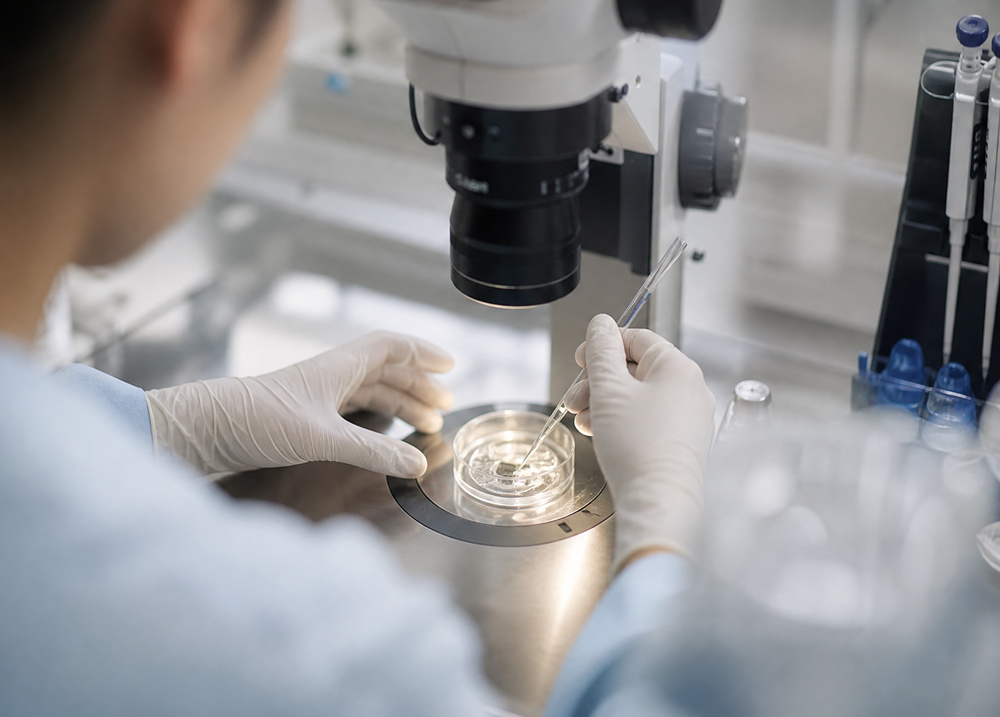

The GM-CSF protein is an important medical aid that helps address the problem of “good-quality embryos but unsuccessful implantation” during the ICSI process. This protein is added to the embryo culture medium to simulate an environment that is as close as possible to the natural uterine cavity. It helps increase the chance of success through three main mechanisms: reducing cellular stress, regulating the mother’s immune balance so that it does not resist the embryo, and promoting early placental development. This technology is therefore particularly suitable for those who have experienced multiple unsuccessful embryo transfers, those with recurrent miscarriages, and those of advanced maternal age or with a small number of embryos, in order to increase the chance of successful embryo implantation and development into a healthy pregnancy.
A heartbreaking problem for many families who decide to rely on IVF or ICSI technology is that, despite carefully nurturing the embryo until reaching a complete and beautiful stage, when it is time to transfer the embryo back into the uterine cavity, pregnancy does not occur as expected. This is because the most important connection in this process is not only fertilizing the egg with sperm to obtain an embryo, but also the factor of the “environment” that is ready to support the embryo as it implants into the uterine wall, which is an important point for achieving a successful pregnancy. This is where medical science has introduced “GM-CSF protein” to help increase the chance of embryo implantation by creating an environment that mimics nature as completely as possible, supporting and increasing the chance of success.
Embryo culture in the IVF/ICSI process requires an environment that is suitable for embryo development through to the Blastocyst stage. Currently, embryo culture media containing GM-CSF (Granulocyte-Macrophage Colony-Stimulating Factor) have been developed. GM-CSF is a protein naturally found in the environment of the reproductive system.
The addition of GM-CSF to the embryo culture medium aims to support embryo development and help create a culture environment that is more similar to the natural environment, particularly during the period when the embryo continuously undergoes cell division and development before proceeding to the embryo transfer stage.
GM-CSF is involved in communication between the embryo and its surrounding environment, including the cellular stress response process. Therefore, it has been incorporated as a component of embryo culture media to help support the embryo during culture before it is transferred back into the uterine cavity.
The quality and development of the embryo before proceeding with the transfer back is another important factor in IVF/ICSI treatment. Embryo culture media containing GM-CSF are therefore used to support the environment during embryo culture and promote appropriate embryo development until it reaches the stage ready for transfer back into the uterine cavity.
After the embryo develops and is transferred back into the uterine cavity, the environment around the endometrium remains an important factor for implantation. GM-CSF is associated with communication between the embryo and the endometrium. Therefore, the use of GM-CSF in embryo culture media has been studied to support an environment conducive to the implantation process and the initiation of pregnancy.
GM-CSF protein (Granulocyte-Macrophage Colony-Stimulating Factor) is an important protein that the body naturally produces during pregnancy. After fertilization occurs and the embryo gradually travels through the fallopian tube to the uterine cavity, the mother’s body releases this substance to serve as a “key” to successful pregnancy.
The role of GM-CSF protein in increasing the chance of pregnancy is related because this protein acts like a safety caretaker in 3 main dimensions:
To provide a clearer picture of how GM-CSF protein helps increase the chance of embryo implantation and positively affects pregnancy, let’s take a closer look at the 3 important mechanisms that act like protective barriers and important driving forces in this process.
Cellular Stress Protection & Energy Support
During the early stage, cells require a tremendous amount of energy to divide, grow, and travel to the uterine cavity. This causes cells to experience stress, which is one of the main causes that can make embryos weaker, stop developing, or deteriorate along the way.
In particular, cryopreserved embryos often have higher levels of accumulated cellular stress than normal, which may more easily lead to Apoptosis, or the breakdown of cells.
Immune Tolerance & Modulation
Normally, the immune system in the uterine cavity acts as a security unit that monitors and eliminates all types of foreign substances from the body. Since the embryo that is about to implant contains half of its genetic material or DNA from the male partner, the woman’s immune system may mistakenly recognize the embryo as an intruder and respond against it, preventing the embryo from implanting.
In this process, GM-CSF communicates with the immune system around the uterine lining to calm it down and create familiarity, telling the mother’s body that what is about to implant is not an enemy, but a new life that needs to be protected.
This mechanism helps reduce the activity of certain immune cells responsible for destroying foreign substances, while also promoting the endometrium’s acceptance of the embryo. This makes the uterine cavity more prepared for implantation and helps the beginning of pregnancy proceed smoothly and safely, reducing the chance that the body will reject the embryo from the early stage of implantation.
Early Placentation & Attachment Support
During the implantation process, the outer cells of the embryo develop into Syncytiotrophoblast, whose most important function is to penetrate the uterine lining to create the placenta, which is used to absorb nutrients and oxygen from the mother’s blood vessels.
If the cells do not have sufficient energy during this process, the embryo may not attach firmly and may easily detach. GM-CSF protein helps increase the chance of embryo implantation by stimulating the outer cells of the embryo to fully develop into Syncytiotrophoblast.
These cells are the “front line” responsible for penetrating and implanting deeply into the uterine wall. They also help stimulate the production of the pregnancy hormone (hCG) to become more stable, thereby helping reduce the risk of embryo detachment and allowing pregnancy to begin strongly and safely.
In ICSI, which is an in vitro fertilization process, embryos need to be carefully maintained inside an Incubator where important factors are strictly controlled, such as temperature, gas proportions, humidity, and acid-base balance, in order to mimic the conditions inside the mother’s body as closely as possible.
However, even when physical factors can be well controlled, an important limitation of culturing embryos outside the body is that it still lacks important secretions and proteins naturally present in the mother’s body. Therefore, adding GM-CSF protein to the embryo culture medium is a technology that helps simulate the natural environment and effectively support embryo development during the early stage.
The use of embryo culture medium containing GM-CSF protein to help increase the chance of embryo implantation is particularly suitable for those who have these obstacles:
It is highly safe because GM-CSF is not a foreign chemical substance, but a basic protein that is naturally present in the human body. Its use in the ICSI process simply mimics substances naturally secreted by the mother to help support the embryo during its early stages.
Yes, they can be performed together. Chromosome testing helps screen embryos that are genetically normal, while GM-CSF-supplemented culture medium helps prepare the embryo for stronger implantation after it is transferred back into the uterus.
GM-CSF protein does not help correct the quality of the original reproductive cells, such as eggs or sperm. The role of this protein begins only after fertilization has occurred and the cells have developed into an embryo.
The overall timing continues according to the normal ICSI procedure because it only involves changing the type of culture medium used to culture the embryos in the incubator.