



Does Frequent Intercourse Really Increase the Chances of Getting Pregnant? Understanding the Facts and Proper Ways to Improve Fertility
Table of Contents
ToggleMany couples who are planning to have a baby may have heard the belief that “the more frequently you have sexual intercourse, the higher the chance of getting pregnant.” As a result, some couples try to have intercourse every day or even several times a day, hoping to increase the chance of fertilization. However, the frequency of sexual intercourse alone is not the only factor determining the chance of pregnancy. Pregnancy depends on several factors, including having intercourse at the right time in relation to ovulation, egg and sperm quality, reproductive health, and the age of both partners.
Even when a couple has regular intercourse, underlying fertility problems may make it more difficult to conceive. Therefore, understanding how pregnancy occurs, the appropriate frequency of intercourse, and when to undergo a fertility evaluation can help couples plan for pregnancy appropriately and receive targeted treatment if an abnormality is found.
Does Frequent Intercourse Really Make It Easier to Get Pregnant?
The answer is “not necessarily.”
Although having intercourse more frequently may increase the chance of sperm meeting the egg, if intercourse does not occur around the time of ovulation, or if there are underlying fertility factors, it may not significantly increase the chance of pregnancy.
Therefore, what matters more than the number of times you have intercourse is having intercourse at the right time and maintaining a healthy reproductive system in both partners.
How Does Pregnancy Occur?
Pregnancy occurs when the woman ovulates and sperm can travel to meet the egg and fertilize it. The resulting embryo must then travel to the uterus and successfully implant in the uterine lining for pregnancy to occur.
If any step in this process is affected—whether ovulation, egg or sperm quality, fertilization, or embryo implantation—the chance of pregnancy may decrease, regardless of how frequently the couple has intercourse.
How Often Should You Have Intercourse When Planning to Have a Baby?
Fertility specialists recommend having sexual intercourse every 1–2 days during the days leading up to and around ovulation.
This is because:
- Sperm can survive in the female reproductive tract for approximately 3–5 days.
- An egg remains viable for only about 12–24 hours after ovulation.
Therefore, having intercourse every other day during the fertile window is sufficient to increase the chance of fertilization. There is no need to have intercourse several times a day.
Why Am I Still Not Pregnant Despite Having Regular Intercourse?
If you have regular intercourse around ovulation but still cannot conceive, there may be underlying fertility factors, such as reduced egg quantity or quality, polycystic ovary syndrome (PMOS), endometriosis, blocked fallopian tubes, hormonal abnormalities, or reduced sperm quality in terms of sperm count, motility, or morphology.
There may also be a high level of sperm DNA fragmentation. These conditions cannot be determined simply by observing symptoms. A fertility evaluation by a specialist is necessary to identify the underlying cause and develop an appropriate treatment plan.
When Should You Have a Fertility Evaluation?
If you have been trying to conceive without contraception and have regular intercourse for:
- 1 year if the woman is under 35 years old
- 6 months if the woman is 35 years old or older
and pregnancy has not occurred, a fertility evaluation should be considered.
Having a fertility evaluation does not mean that you need to undergo IVF immediately. The purpose is to identify the underlying cause so that an appropriate treatment plan can be developed.
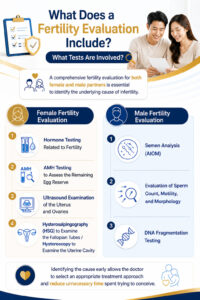
What Does a Fertility Evaluation Include?
Both the female and male partners should be evaluated because infertility can result from factors affecting either partner.
Female Fertility Evaluation
- Hormone testing related to fertility
- AMH testing to assess the remaining egg reserve
- Ultrasound examination of the uterus and ovaries
- Hysterosalpingography (HSG) to examine the fallopian tubes / hysteroscopy to examine the uterine cavity
Male Fertility Evaluation
- Semen analysis (AIOM)
- Evaluation of sperm count, motility, and morphology
- DNA Fragmentation testing when indicated
Identifying the cause early allows the doctor to select an appropriate treatment approach and reduce unnecessary time spent trying to conceive.
What Treatment Options Are Available If Infertility Is Diagnosed?
Once the cause has been identified, the doctor will develop a treatment plan appropriate for each couple. Treatment options may include:
- Lifestyle and health modifications
- Ovulation-inducing medication
- Intrauterine insemination (IUI)
- Intracytoplasmic sperm injection (ICSI)
Having frequent intercourse does not necessarily mean that you will have an easier time getting pregnant. What matters is having intercourse around the time of ovulation, as well as maintaining reproductive health in both partners. If you have been trying to conceive for some time without success, a fertility evaluation can help identify the underlying cause and determine the most appropriate treatment plan.
At VFC – Fertility Technology Center (V-Fertility Center), we offer comprehensive fertility evaluation programs for both women and men to identify potential causes of infertility. Our team provides personalized consultation and treatment planning, including IUI or ICSI, based on the individual needs of each couple.
Article by Dr. Worawat Siripoon
Obstetrics and Gynaecology-Reproductive Medicine
Contact or Book a Consultation:
VFC Center – V-Fertility Center
Hotline: 082-903-2035
LINE Official: @vfccenter
FAQs
Not necessarily. Although Frequent Intercourse may increase the chance of sperm meeting the egg, there is no evidence that having intercourse every day improves pregnancy rates compared with every 1–2 days in couples with normal reproductive health. The key is to have intercourse during the fertile window around ovulation. If you have Frequent Intercourse without contraception for 1 year (if the woman is under 35) or 6 months (if the woman is 35 or older) and pregnancy has not occurred, a fertility evaluation is recommended to identify the underlying cause and develop an appropriate treatment plan. Yes, particularly the woman’s age. As women age, both the number and quality of their eggs gradually decline, which can reduce the chances of pregnancy. Therefore, if you are planning to have a baby and have been trying for some time without success, it is recommended to undergo a fertility evaluation as soon as possible. Abstaining from ejaculation for a longer period may increase semen volume, but it does not necessarily improve sperm quality. In some cases, sperm motility may decrease or DNA fragmentation may increase. Therefore, having intercourse or ejaculating every 1–2 days while trying to conceive may be appropriate. For couples with medical indications, IVF with ICSI is an assisted reproductive technology that can help increase the chance of pregnancy. However, success rates depend on several factors, including age, egg quality, sperm quality, and the underlying cause of infertility. Therefore, a comprehensive fertility evaluation before starting treatment is an important step. Does Frequent Intercourse every day really help you get pregnant more easily?
We have Frequent Intercourse regularly but still cannot get pregnant. What should we do?
Does age affect the chances of getting pregnant?
Does avoiding ejaculation for several days improve sperm quality?
Can IVF with ICSI help increase the chances of getting pregnant?

สูตินรีแพทย์เฉพาะทางด้านเวชศาสตร์การเจริญพันธุ์
OBSTETRICS AND GYNAECOLOGY-REPRODUCTIVE MEDICINE
No Comments
Sorry, the comment form is closed at this time.